World’s first AI photonic processor fires up
 Cette publication existe aussi en Français
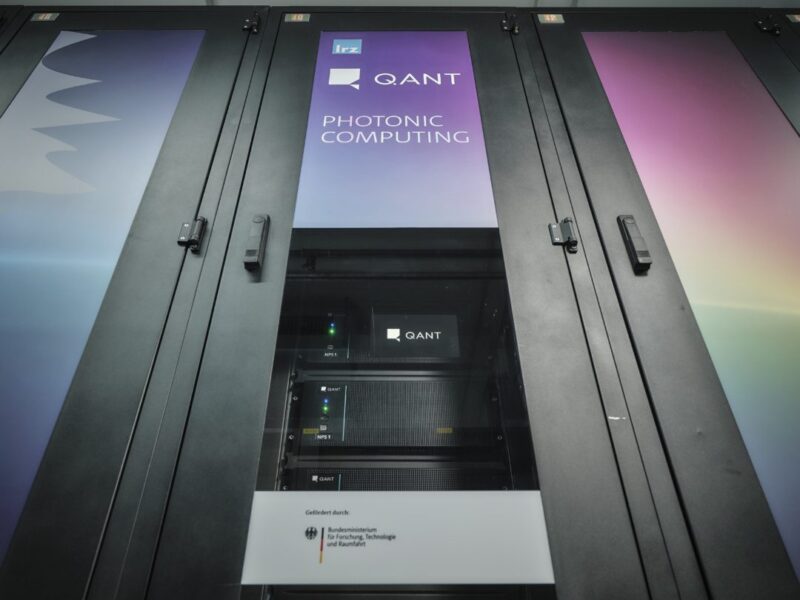
German photonic processor developer Q.ANT has delivered its Native Processing Server (NPS) to the Leibniz Supercomputing Centre (LRZ), marking the first integration of an analog photonic co-processor into an operational high-performance computing (HPC) environment.
This is the first deployment that enables LRZ to evaluate photonic acceleration for artificial intelligence (AI) and simulation workloads with drastically lower energy consumption. LRZ is one of the largest datacentres in Europe with cutting-edge infrastructure and pioneering research.
The collaboration is aimed at researching hybrid digital-analog architectures for future HPC environments and is funded by the German Federal Ministry of Research, Technology and Space. Deploying Q.ANT’s NPS, LRZ expands this scope to include photonic analog computing.
- Q.ANT raises €62m to scale up photonic processor production
- Pilot line for photonic processor production
LRZ will use the Q.ANT NPS in a research project to establish new benchmarks and real-world use cases for applications such as climate modeling, real-time medical imaging, or materials simulation for fusion research. With this deployment, LRZ is strengthening its role as a pioneer in the development of energy-efficient high-performance computers.
The first evaluation phase at LRZ involves installing several units of the latest generation Q.ANT NPS, selecting benchmark workloads, and testing real-world applications — particularly in AI inference, computer vision, and physics simulations. Later phases will include second- and third-generation NPS units for deeper evaluation.
Q.ANT’s photonic chip generates no heat, so costly cooling measures are unnecessary. The optical processing also means complex calculations can also be performed faster and more efficiently with up to 90x lower power consumption per workload, due to the absence of on-chip heat and reduced cooling requirements. This can provide 100x increase in datacentre capacity enabled through greater computational density and faster execution of complex operations says Q.ANT.
“Photonic processors offer a novel and promising path to accelerate AI and simulation workloads, while sharply reducing our environmental footprint. This deployment marks a milestone in our future computing mission to advance energy-efficient AI and high-performance computing,” said Prof. Dr. Dieter Kranzlmüller, Chairman of the Board of Directors of LRZ. “Q.ANT’s NPS integrates easily into our existing infrastructure, allowing us to immediately evaluate its performance. Bringing in future technologies and opening up new avenues for our users would, however, not be possible without the continuous support from both the federal and Bavarian government.”
“Our collaboration with LRZ marks a pivotal milestone: for the first time in history, we’re operating photonic processors in an HPC under practical workloads. With this step, we demonstrate that light-based processors have moved beyond research and into real-world application,” said Dr. Michael Förtsch, CEO of Q.ANT. “This is a decisive step toward integrating photonic computing into the mainstream of next-generation computer architecture by 2030. The long-term commitment of the Ministry for Research, Technology and Space has been instrumental in enabling the breakthroughs that made this success possible.”
 If you enjoyed this article, you will like the following ones: don't miss them by subscribing to :